 Beefy
Beefy
Beefy ZAP converts supported tokens into assets for a first vault deposit
Beefy ZAP can fund a first vault deposit from a supported token when the selected product offers a usable route. That route can swap the starting token, build the required liquidity, and deposit the resulting asset. Both same-chain and supported crosschain routes exist, with different completion requirements. The token that leaves your wallet may differ from the assets that the vault holds. Before authorizing anything, identify the destination product, examine the quoted output, and reserve native gas for transactions. A completed vault deposit gives you a receipt representing your position. A displayed route, spending approval, or submitted transaction alone doesn’t establish that final holding.
In this guide
A supported wallet and deposit route establish readiness
A first deposit needs a supported wallet, an available input balance, native gas, and a route into the chosen active product. Connect the wallet and open the intended product’s deposit controls. The available token and chain selections show which balances the interface can route. A familiar token symbol on another network doesn’t automatically identify an eligible input.
The starting balance must also leave room for transaction costs. Holding a deposit token doesn’t necessarily provide the native gas token that the source chain requires. A quote establishes an available proposal; completion requires the resulting destination holding. Before any approval or submission, you can stop with the proposed deposit unexecuted.
The input token and vault asset have different jobs
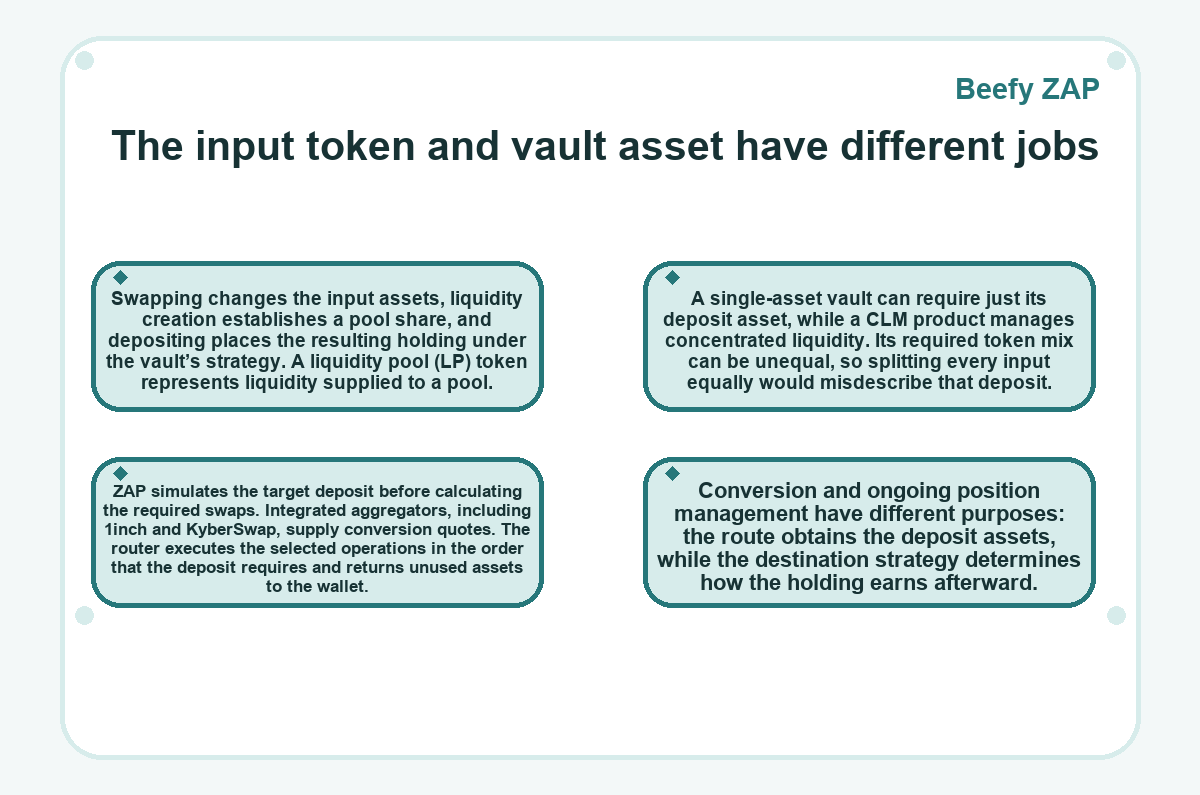
Swapping changes the input assets, liquidity creation establishes a pool share, and depositing places the resulting holding under the vault’s strategy. A liquidity pool (LP) token represents liquidity supplied to a pool. A single-asset vault can require just its deposit asset, while a CLM product manages concentrated liquidity. Its required token mix can be unequal, so splitting every input equally would misdescribe that deposit.
ZAP simulates the target deposit before calculating the required swaps. Integrated aggregators, including 1inch and KyberSwap, supply conversion quotes. The router executes the selected operations in the order that the deposit requires and returns unused assets to the wallet. Conversion and ongoing position management have different purposes: the route obtains the deposit assets, while the destination strategy determines how the holding earns afterward.
The quote shows the cost of reaching the vault
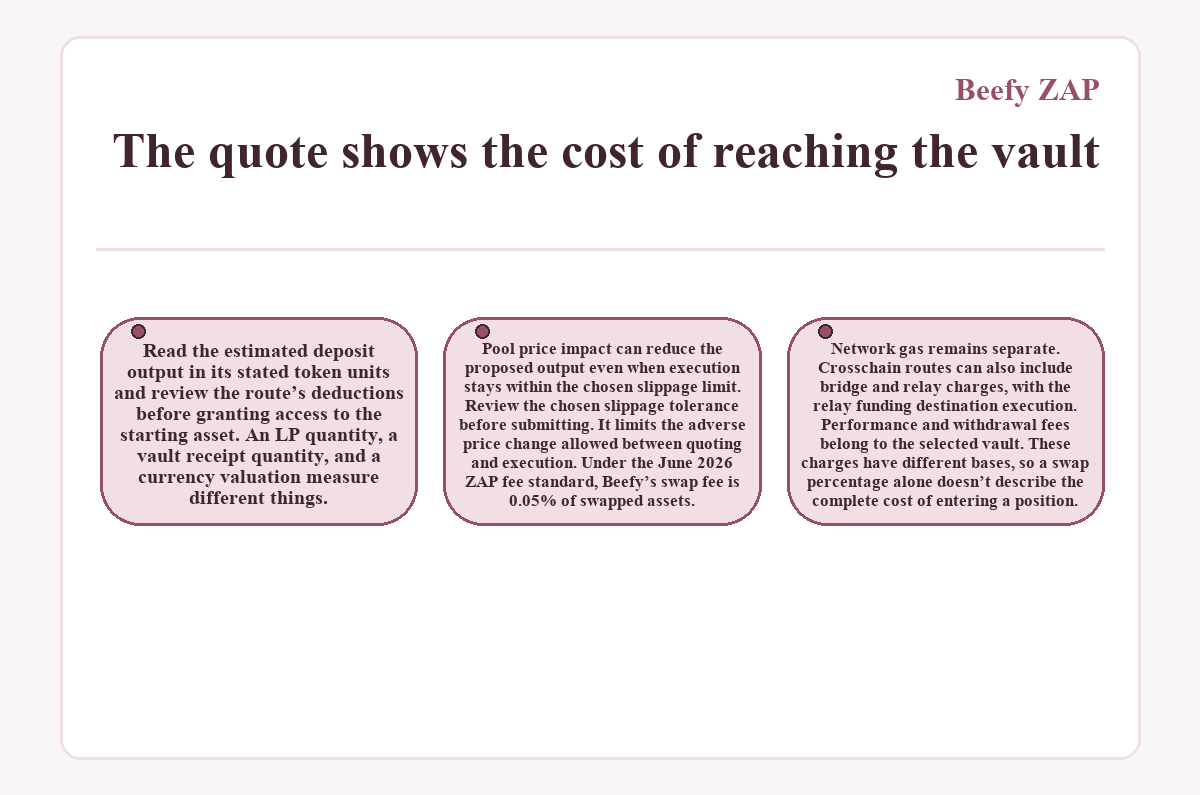
Read the estimated deposit output in its stated token units and review the route’s deductions before granting access to the starting asset. An LP quantity, a vault receipt quantity, and a currency valuation measure different things. Pool price impact can reduce the proposed output even when execution stays within the chosen slippage limit. Review the chosen slippage tolerance before submitting. It limits the adverse price change allowed between quoting and execution.
Under the June 2026 ZAP fee standard, Beefy’s swap fee is 0.05% of swapped assets. Network gas remains separate. Crosschain routes can also include bridge and relay charges, with the relay funding destination execution. Performance and withdrawal fees belong to the selected vault. These charges have different bases, so a swap percentage alone doesn’t describe the complete cost of entering a position.
Spending permission precedes the investment
For an ERC-20 input, spending authorization allows the relevant contract to move the token; the deposit order specifies how ZAP should use it.
Spending authorization
An ERC-20 allowance
An ERC-20 allowance names a spender and an amount. If the allowance for the selected token and spender is insufficient, an approval may precede execution. That permission doesn’t place funds into a vault. Review the requested spending cap before confirming it, because the permitted amount can exceed the intended deposit.
A Permit2-signed order
The router also supports a Permit2-signed order. Permit2 requires an underlying ERC-20 approval before it can move that token. A signed order can therefore rely on an earlier token approval. The selected route and existing permissions determine which approval and signature prompts appear.
Deposit execution
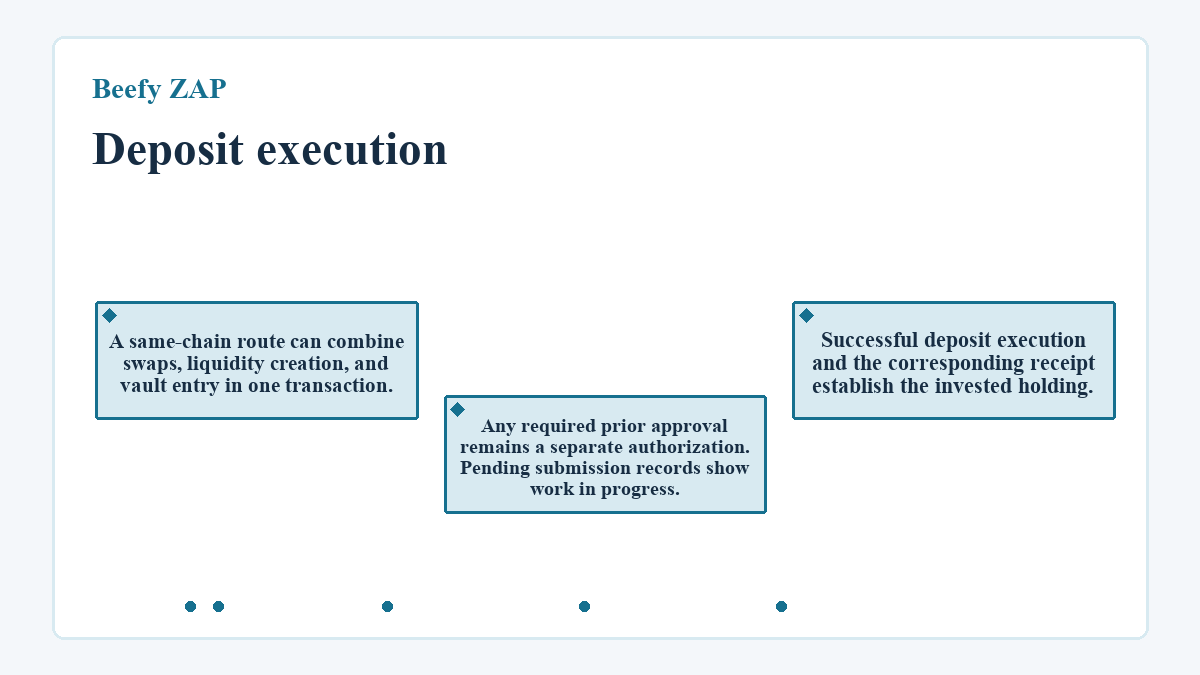
A same-chain route can combine swaps, liquidity creation, and vault entry in one transaction. Any required prior approval remains a separate authorization. Pending submission records show work in progress. Successful deposit execution and the corresponding receipt establish the invested holding.
Can I make my first vault deposit without buying an LP token?
A supported same-chain ZAP route can create and deposit an LP token, so a separate LP purchase isn’t required for that route.
In this hypothetical first session, a wallet holds an eligible starting token on the selected standard LP vault’s chain. The chosen amount fits its balance, and enough native gas remains for any required approval and deposit.
If the deposit controls don’t offer a route for that input, the reader stops before approval. The unchanged input balance remains available while the reader considers a supported token or direct LP deposit.
Where a quote does appear, the reader checks the intended LP vault, estimated output, and spending request. After the necessary authorization, the deposit order converts the input, creates the LP holding, and deposits it. This example assumes successful execution; the quoted amounts alone can’t establish that outcome.
The wallet now holds that vault’s mooTokens, and the vault shows the deposited position. Those receipts confirm vault entry. Receiving only an approval confirmation would leave the first investment unfinished, even though spending permission had changed.
Direct deposits and manual liquidity remain available
A direct deposit uses the vault’s accepted asset without asking ZAP to obtain it first. Where a standard LP vault accepts an existing LP token, that holding can enter directly. Manual liquidity creation provides another approach: obtain the pool’s required assets and proportions, supply them through its liquidity interface, and use the resulting LP token for deposit. This approach adds separate operations and costs. A missing ZAP quote doesn’t, by itself, show that the vault can’t accept its specified deposit asset.
A crosschain route must finish on the destination chain
Crosschain ZAP connects source-chain funds to a destination product through Circle’s Cross-Chain Transfer Protocol, or CCTP, using USDC for the bridge transfer. When necessary, the source route first converts the input into USDC. CCTP burns that USDC on the source chain and mints it on the destination chain. The destination receiver then attempts the requested deposit and returns the product receipt after successful execution.
A successful source transaction doesn’t establish that the destination vault has accepted the funds. Beefy’s Hook Executor obtains the bridging attestation and triggers destination processing. The receiver handles the deposit separately from source execution, including refund or recovery outcomes if that deposit fails. The app’s progress state and destination balances distinguish an ongoing transfer from a completed holding.
Receipt tokens and withdrawal choices define the position
A standard Beefy vault’s mooTokens represent the holder’s share of its deposited assets. CLM products have their own receipt layers: a CLM Pool can return rcowTokens, while a CLM Vault uses mooBeefy tokens. Receipt quantities needn’t match the number of input tokens, because they measure different holdings. Preserve the receipt associated with the chosen destination.
A direct LP vault withdrawal can return LP tokens. A supported withdrawal ZAP can remove liquidity and convert the output into a selected available token. The route that funded entry doesn’t guarantee an identical route or quote on exit. Withdrawal choices, conversion liquidity, and the vault’s own fees can change what comes back to the wallet.
Sonic products stopped earning yield
Retired Beefy products can remain visible in the app even though they no longer earn yield. The Sonic retirement stopped yields and preserved withdrawal access for remaining vault positions. Crosschain ZAP routes out of those holdings were available; their presence didn’t reopen the products for earning. Beefy announced the Sonic deprecation on October 6, 2026.
Beefy ZAP: frequently asked questions
Can tokens held on a centralized exchange fund my first ZAP deposit?
Tokens held in a centralized exchange account must reach your connected wallet before they can fund its ZAP deposit. The exchange withdrawal network needs to match the supported input network. A balance displayed inside an exchange account isn’t a spendable balance in the wallet connected to Beefy. The wallet also needs the source chain’s native gas token for transactions.
How can I display the receipt from my first ZAP deposit in MetaMask?
MetaMask can display an unlisted receipt token when you import its correct contract address on the deposit’s destination network. Use the receipt contract for the vault that actually received the funds, since an LP token and a vault receipt identify different holdings. Importing a token changes the wallet’s display; it doesn’t create a deposit or move funds.
Does disconnecting after a first ZAP deposit revoke my ERC-20 approval?
Disconnecting your wallet doesn’t revoke the ERC-20 spending approval used for a ZAP deposit. Any remaining allowance stays onchain until it’s consumed or changed, including through revocation. Wallet disconnection removes the app connection. Revoking an onchain approval requires a separate transaction and gas, even if you stopped before making the actual deposit.
What happens if I close the app during my first crosschain ZAP?
Closing the app doesn’t cancel a crosschain ZAP that has already been submitted. The app can display progress and offer continuation when execution stalls. Depending on the stage, funds may be in your input token or USDC on the source chain. On the destination chain, they may be in USDC, the product’s deposit assets, or its receipt. The transfer may also await CCTP minting. Check balances on both chains before submitting another deposit. Beefy’s technical support can assist when the interrupted transfer isn’t visible in the interface.
Will a Free Zap promotion cover my first token-to-vault deposit?
A Free Zap label doesn’t establish a fee waiver for a first token-to-vault deposit. The June 19, 2026 launch campaign excluded those deposits and waived Beefy’s swap fee only on promoted vault-to-vault routes. Gas and any bridge or relay fees still applied. Eligibility follows the campaign’s included routes, so the deposit method matters.