 Beefy
Beefy
Beefy CLM resets liquidity ranges without selling tokens to rebalance the position
Beefy CLM resets concentrated liquidity ranges by dividing pooled assets between a main position and a single-sided alt position. That arrangement accommodates an uneven token mix without a corrective swap between the pool’s assets. Pool trading still changes token balances, and range resets don’t remove impermanent loss.
An equal-value main position can coexist with uneven total exposure because CLM’s alt retains the excess pool asset.
The main position pairs assets and the alt holds the excess
The main position uses both pool assets, while the alt deploys the surplus that doesn’t fit that allocation. Beefy’s Cowcentrated Liquidity Manager, or CLM, pools those assets under one strategy. At placement, the main position targets a 50/50 allocation by value around the pool’s current price. That proportion concerns capital value, not equal numbers of token units. The alt holds whichever asset is overweighted in a narrower, single-sided position. Together, the ranges accommodate the token mix that the strategy actually has.
A tick is a permitted price boundary in the pool. The alt uses tick boundaries within the main range, on the side appropriate to the surplus asset. In pools that pay trading fees, its liquidity earns them when price trades within that interval. Placing tokens in the alt doesn’t guarantee that every part of the holding earns fees continuously.
Range placement changes without a balancing sale
Range resetting removes liquidity from its previous bounds and redeploys the available pool assets around a new price. Accounting preserves pooled ownership of both tokens through that change. Harvesting also brings earned trading fees back into the managed capital, after applicable performance fees. Reinvested trading fees can increase the amounts available for redeployment, even when the reset doesn’t swap principal tokens.
The alt lets the strategy redeploy an uneven token mix without selling one pool asset to purchase the other. A strategy that restores an equal mix through swaps changes how much of each token it holds. Moving liquidity boundaries and changing the token mix are different operations.
A ZAP deposit may exchange its input into the pool assets, and ZAP withdrawals may exchange them into an output token. These conversions belong to entry or exit.
Underlying pool swaps continue between resets. While a managed position is in range, those swaps exchange its assets with traders and change the composition that the next adjustment inherits.
Can the alt position become larger than the main position?
Yes, the alt can become the larger portion when trading leaves the pooled assets increasingly uneven in value. Narrower ranges can make those changes faster because relatively small price moves shift more of the position toward one token. An expanding alt can mean greater exposure to the underperforming asset. Resetting the range continues to use those balances; it doesn’t impose a fixed equal-value allocation across the whole holding.
Impermanent loss continues while the pool trades
Impermanent loss measures the effect of a liquidity position’s changing asset quantities against holding the same starting assets. Fees earned from trades can offset that difference, but the two effects need separate accounting. A profitable-looking fee stream doesn’t establish that providing liquidity outperformed holding the tokens.
CLM remains exposed to impermanent loss. This exposure begins while liquidity trades inside its range. Buyers and sellers change the position’s quantities of both assets as their relative price moves. Keeping that liquidity deployed allows trading to continue, together with the resulting changes in exposure.
A swap that restores an equal asset mix can realize losses accumulated through earlier pool trading and incur trading costs. CLM avoids that corrective sale when repositioning within range. That design addresses a particular source of losses; it doesn’t establish superior returns for every pool or price path.
A useful return comparison includes current asset values, earned fees, and relevant costs. Range activity alone doesn’t establish the financial outcome.
A balanced main position can sit inside an uneven holding
A completed range reset can leave the total position weighted toward one asset. In this hypothetical case, one pool asset is overweighted, prices don’t change during the adjustment, and the intended holding is an equal-value mix.
The strategy puts matched capital into the main range and the surplus asset into the alt. The main allocation can be 50/50 by value even though the combined holding contains more value in one token. Looking only at the main position would miss the additional exposure that the alt carries.
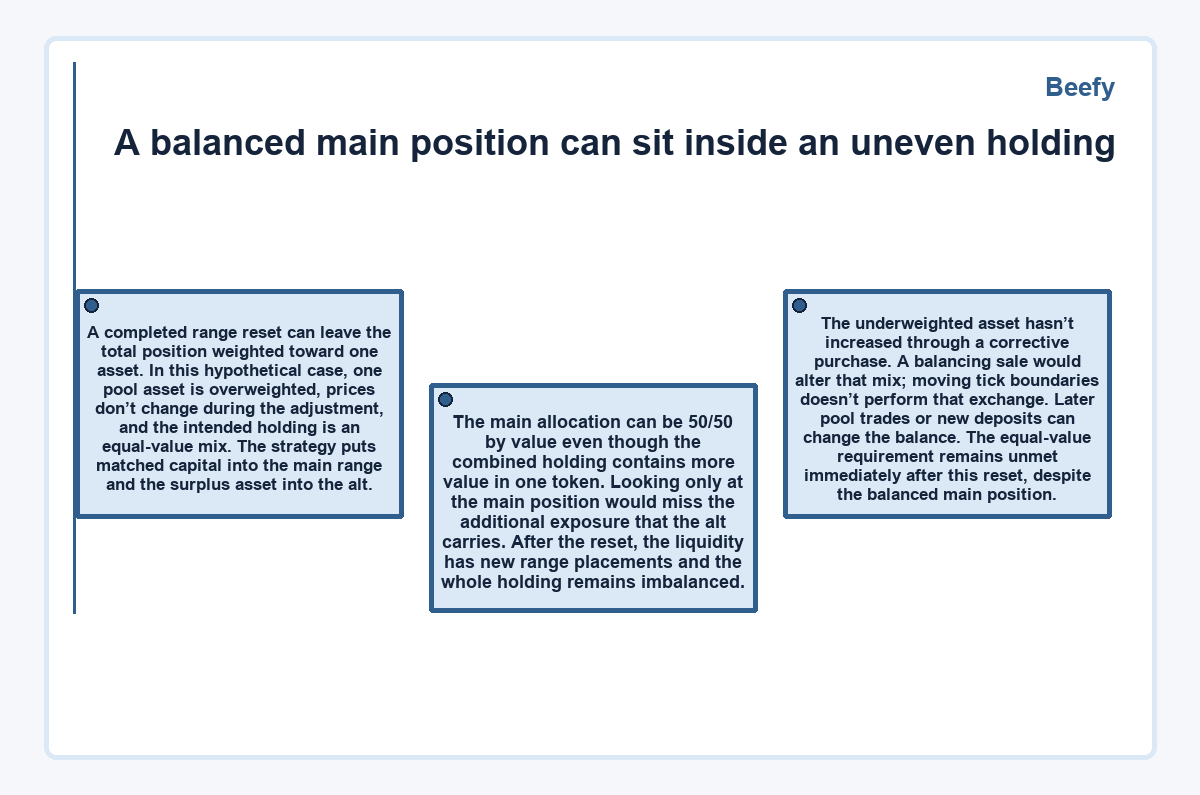
After the reset, the liquidity has new range placements and the whole holding remains imbalanced. The underweighted asset hasn’t increased through a corrective purchase. A balancing sale would alter that mix; moving tick boundaries doesn’t perform that exchange.
Later pool trades or new deposits can change the balance. The equal-value requirement remains unmet immediately after this reset, despite the balanced main position.
How does a sharp price move limit a range reset?
Rapid price movement can push liquidity beyond its boundaries before a range adjustment returns it to an earning interval. An out-of-range position stops earning trading fees and can hold only one pool asset. Its token quantity then stays unchanged by pool trading while its market value continues to move. The alt reduces the need for corrective sales, but its own boundaries don’t cover every possible price.
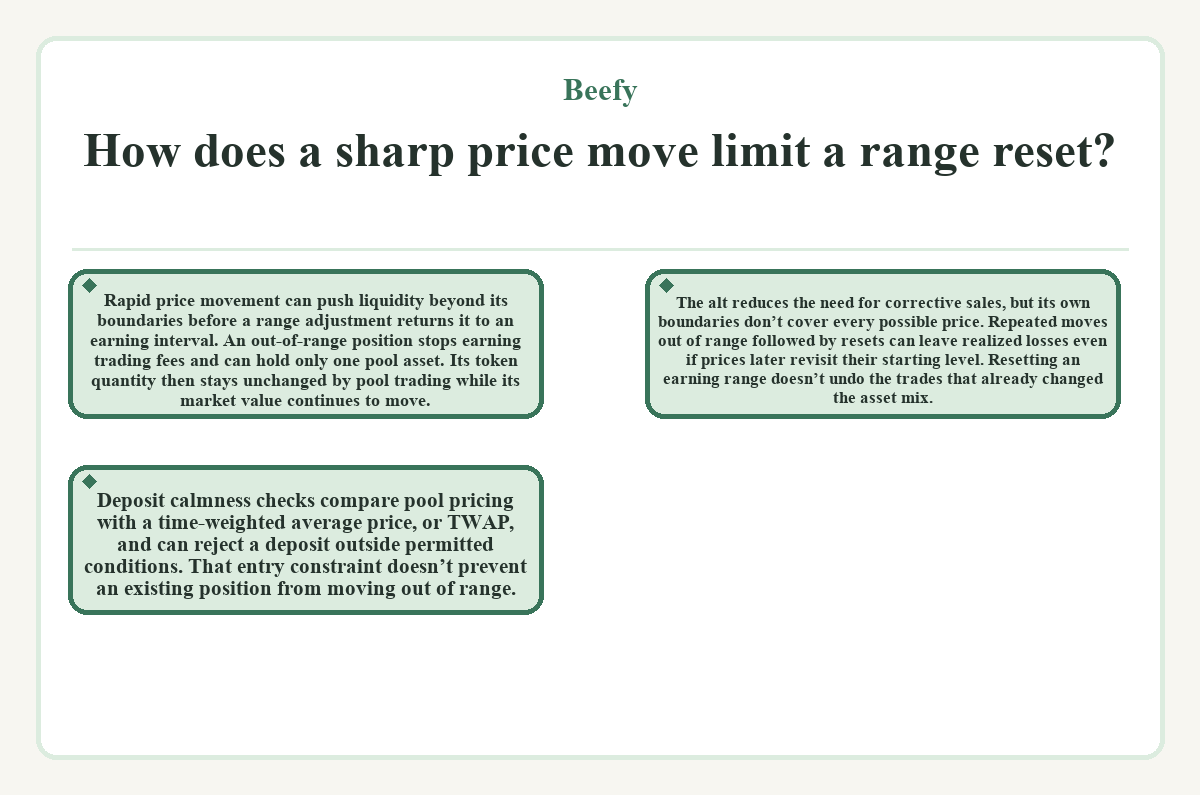
Repeated moves out of range followed by resets can leave realized losses even if prices later revisit their starting level. Resetting an earning range doesn’t undo the trades that already changed the asset mix. Deposit calmness checks compare pool pricing with a time-weighted average price, or TWAP, and can reject a deposit outside permitted conditions. That entry constraint doesn’t prevent an existing position from moving out of range.
Reward harvesting and range maintenance change different things
Trading-fee harvests add earned pool assets to the managed position; a range adjustment changes the boundaries where that capital trades. These operations can occur together.
Additional incentive rewards follow their own product layer. A CLM Pool lets rewards accrue for claims, while an autocompounding CLM Vault can collect incentives, swap them into principal assets, and redeposit them. That reward swap serves compounding. It doesn’t imply a sale that equalizes the underlying liquidity position.
Some pools reward liquidity through incentive tokens instead of trading fees. The applicable product layer determines whether those incentives remain claimable or are reinvested.
Range parameters belong to the managed strategy
Range selection belongs to the pooled strategy, so an individual deposit doesn’t set private tick boundaries for one wallet. Automated calls update the managed ranges. Range width sets the price interval where liquidity can trade and affects how quickly price movement creates uneven balances. Depositors participate in that shared configuration.
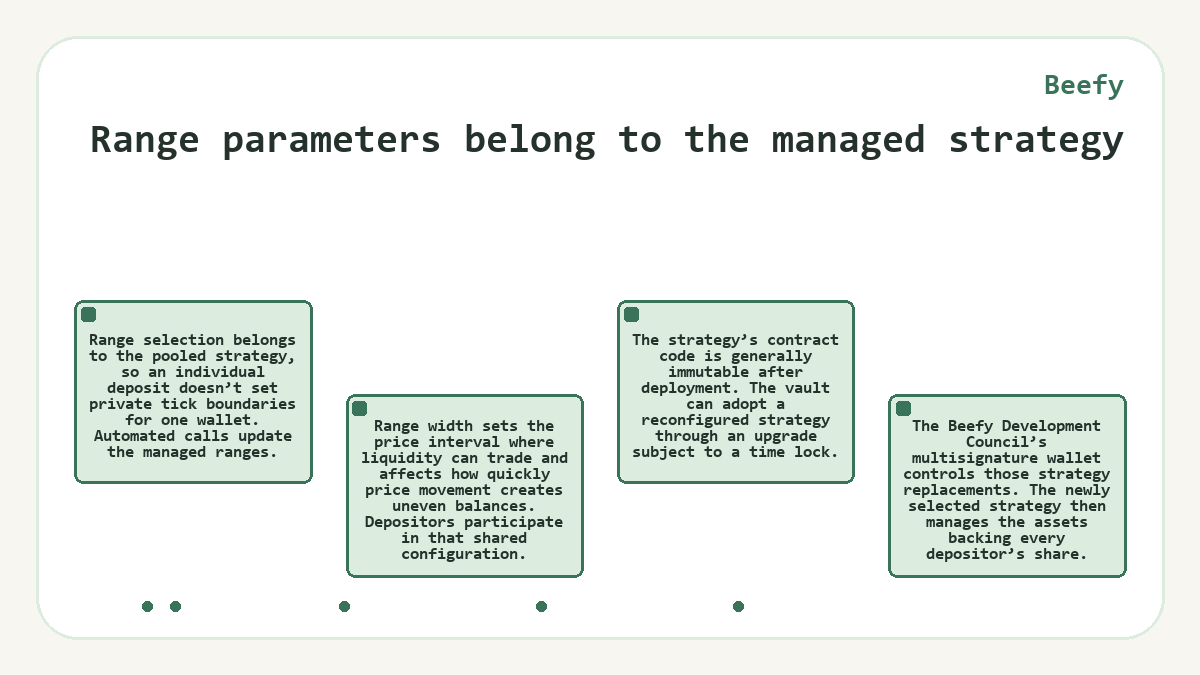
The strategy’s contract code is generally immutable after deployment. The vault can adopt a reconfigured strategy through an upgrade subject to a time lock. The Beefy Development Council’s multisignature wallet controls those strategy replacements. The newly selected strategy then manages the assets backing every depositor’s share.
Common questions about Beefy
Does a direct CLM deposit always use the full amount offered?
A direct CLM deposit doesn’t always use every offered token. An imbalanced product can accept the underweighted asset until it reaches a 50/50 balance by value. Beyond that point, additional capital needs both assets in equal values. Any offered tokens that the deposit can’t use remain with or return to the wallet.
Can depositing a single pool asset keep my CLM exposure entirely in that asset?
An accepted single-asset direct deposit gives you a share of the product’s pooled asset mix. That share may include the other pool token, even though the wallet supplied only one asset. The single-sided alt describes part of the strategy’s liquidity placement; it isn’t a separate personal holding that preserves a depositor’s original token choice.
Which assets come back from a direct CLM withdrawal after the token mix changes?
A direct CLM withdrawal returns a proportional share of the assets that the product currently holds. The redeemed receipt represents ownership of those balances, including any imbalance carried through the main and alt positions. The amounts can differ from the original deposit because trading and earnings have changed the pooled holding.
What does a negative CLM vs Hold figure say about an imbalanced position?
A negative CLM vs Hold figure means the CLM position has less dollar value than its displayed holding benchmark. That benchmark models the deposit value split equally between the two pool assets, with no further activity. A larger alt alone doesn’t determine the comparison’s sign. The current token quantities and market prices also matter.
How often are CLM ranges adjusted?
Range adjustments follow the deployed strategy’s automation and its conditions. The August 2024 CLM design specified a six-hour schedule alongside deposit and harvest activity. The July 2026 Ethereum launch described adjustment near range boundaries and additional reset checks. These controls don’t establish a guaranteed response time during volatility, or a single fixed interval for every deployment.
Are retired Sonic CLM positions still earning yield?
Beefy’s Sonic products stopped earning yield when that integration retired on October 6, 2026. The remaining funds are held in the strategies and available to withdraw. Retired positions appear under My Positions after connecting the relevant wallet.
What causes an imbalance swap fee on a direct CLM deposit?
An imbalance swap fee compensates existing depositors when a direct deposit changes their exposure through the shared token mix. Supplying one asset can give the incoming depositor a claim on the other asset. The fee addresses that implicit exchange and depends on deposit size and imbalance. It is distinct from selling pooled tokens to rebalance a liquidity range.