 Beefy
Beefy automates DeFi vault compounding and concentrated liquidity management
Beefy is a multichain yield optimizer that reinvests crypto rewards through vault strategies and manages concentrated liquidity through CLM products. Vaults can hold single assets or liquidity pool tokens, while CLM directly manages liquidity positions. Some products compound earnings into the position; others leave additional rewards available to claim. BIFI connects the protocol’s governance and revenue incentives.
The distinction starts with what generates earnings and where those earnings go. A farm reward, a pool’s trading fee, and a separately claimable incentive follow different paths. That difference affects the asset exposure and withdrawal options that each product provides.
Vault compounding and CLM manage different parts of a position
Where a farm supplies reward tokens, a vault reinvests those rewards; CLM directly manages liquidity and can earn trading fees without farm incentives. These functions can also operate together. A CLM Vault adds a reward-compounding strategy above managed liquidity.
Single assets and liquidity pool shares
A single-asset vault can use a lending market or a single-token reward pool. Its strategy determines how the deposited asset earns yield. An LP vault holds liquidity pool tokens that represent exposure to the pool’s assets. The strategy typically stakes those tokens in a farm, collects incentives, swaps rewards into the principal assets, and rebuilds the LP holding. The pool can also earn trading fees. Sharing the automation across depositors reduces repeated manual harvesting, although each deposit and withdrawal still has its own network costs.
Direct concentrated liquidity management
CLM stands for cowcentrated liquidity manager. It manages liquidity within selected price ranges, where trading can generate fees. During a deposit or harvest, the product resets its positions. It places matched token values in a main position and excess tokens in a separate, single-sided alt position. This arrangement deploys an imbalanced token holding without selling tokens merely to restore equal values. Range management changes where the liquidity earns fees; it doesn’t remove exposure to either pool asset.
CLM shares and reward layers have different receipt tokens
With a CLM Pool, receipt tokens represent managed liquidity and access to separate incentives; a CLM Vault adds an autocompounding strategy above managed CLM liquidity.
A CLM Pool and its receipts
The underlying cowToken share
A cowToken is an ERC-20 token representing a share of pooled CLM assets. Trading fees can increase those assets through reinvestment. That share covers the product’s token holdings in their changing proportions, rather than preserving the original quantities of both assets.
Rewards attached to rcowTokens
The CLM Pool accepts cowTokens and issues rcowTokens at a 1:1 ratio. This ratio compares the two receipt tokens, not either receipt with the underlying pool assets. Pool incentives accrue for holders to claim. The claimable reward token can differ from the assets that form the liquidity position.
An autocompounding CLM Vault
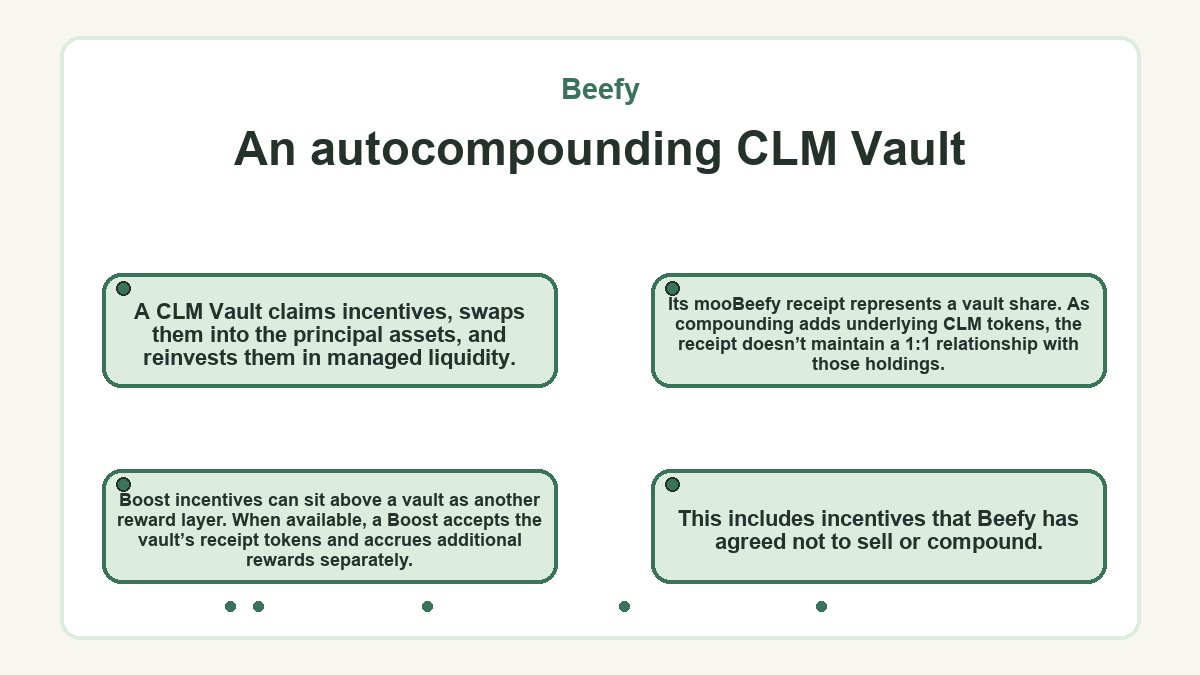
A CLM Vault claims incentives, swaps them into the principal assets, and reinvests them in managed liquidity. Its mooBeefy receipt represents a vault share. As compounding adds underlying CLM tokens, the receipt doesn’t maintain a 1:1 relationship with those holdings.
Boost incentives can sit above a vault as another reward layer. When available, a Boost accepts the vault’s receipt tokens and accrues additional rewards separately. This includes incentives that Beefy has agreed not to sell or compound.
How does compounding change a vault balance?
When a strategy reinvests harvested rewards, each vault share can represent more underlying assets even though the holder’s mooToken balance stays unchanged. The receipt records ownership of a share; it isn’t a counter that adds a new token for every harvest.
For a standard vault, the asset balance divided by outstanding shares determines the underlying assets represented by each share. Compounding changes that relationship. A higher asset balance per share says nothing by itself about the asset’s market price.
Annual percentage yield, or APY, includes a compounding assumption. Annual percentage rate, or APR, describes a simple annualized rate. CLM Pools distinguish compounded trading-fee yield from additional incentives shown as APR. A CLM Vault can compound those incentives too.
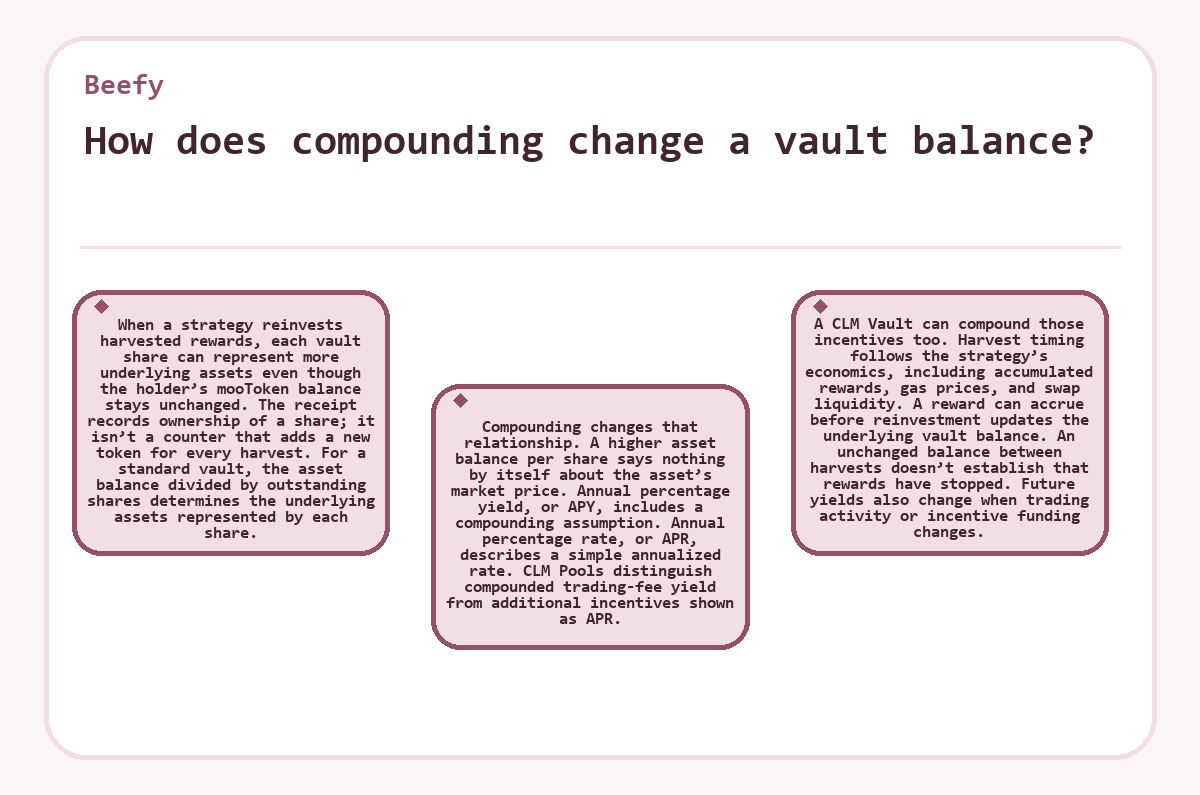
Harvest timing follows the strategy’s economics, including accumulated rewards, gas prices, and swap liquidity. A reward can accrue before reinvestment updates the underlying vault balance. An unchanged balance between harvests doesn’t establish that rewards have stopped. Future yields also change when trading activity or incentive funding changes.
BIFI connects governance with protocol revenue
BIFI is the project’s governance token, and holders use Snapshot to vote on DAO decisions. BIFI has a fixed supply of 80,000 tokens. Protocol fees also fund tokenholder incentives through staking products. The BIFI Vault compounds incentives into BIFI, while the BIFI Pool distributes separately claimable rewards. Those arrangements concern deposits in the relevant incentive products; token ownership alone doesn’t place BIFI into them. Governance participation and a vault’s underlying investment strategy therefore describe different uses of the protocol.
Access choices change the asset received on exit
If a vault accepts an LP token directly, its ordinary withdrawal returns that vault asset; converting it into the pool’s constituent tokens requires removing liquidity. Supported ZAP routes can combine conversion with vault entry or exit. The available input and output tokens depend on the product and route. Crosschain ZAP routes also exist for supported networks and products. Multichain availability doesn’t make every product accessible from every network.
Strategy fees, withdrawal charges where applicable, ZAP conversion costs, and network gas have different charging bases. Performance fees apply to harvested earnings, including CLM trading fees; a CLM Vault also charges a separate fee on incentives it compounds. A withdrawal fee applies where the vault specifies one. Deposits into imbalanced CLM products can also incur a swap fee on the portion deposited to offset the imbalance. Vault APYs include performance fees, while a ZAP quote concerns the selected conversion. Users pay gas for transactions they submit. For crosschain ZAP deposits, the relay fee covers claiming bridged funds and executing the destination deposit. Entry and exit costs therefore need their own comparison.
Automation leaves asset and contract risks in place
For liquidity positions, changing relative prices can leave the holding worth less than simply retaining the starting assets, even while fees accrue. This is impermanent loss. CLM’s alt position changes how it manages imbalances. It doesn’t eliminate that loss, and rapid price movements can take positions outside their earning ranges.
Single-asset strategies have their own dependencies. Some lending strategies borrow and resupply the deposited asset, making borrowing costs and available market liquidity relevant. Heavy borrowing in an underlying lending market can obstruct the strategy’s withdrawal. A single-token deposit therefore doesn’t describe every risk inside the strategy.
Contract failures can also affect the vault, its strategy, or the external protocol holding funds. The app’s Risk Checklist identifies product-specific concerns, including asset correlation and administrative controls. Passing checks doesn’t establish protection against every loss. The applicable contracts and underlying assets determine which risks matter.
Active strategies and retired Sonic positions need different choices
Product status changes the meaning of an existing balance: an active strategy can earn yield, while a retired position can hold withdrawable assets without further earnings.
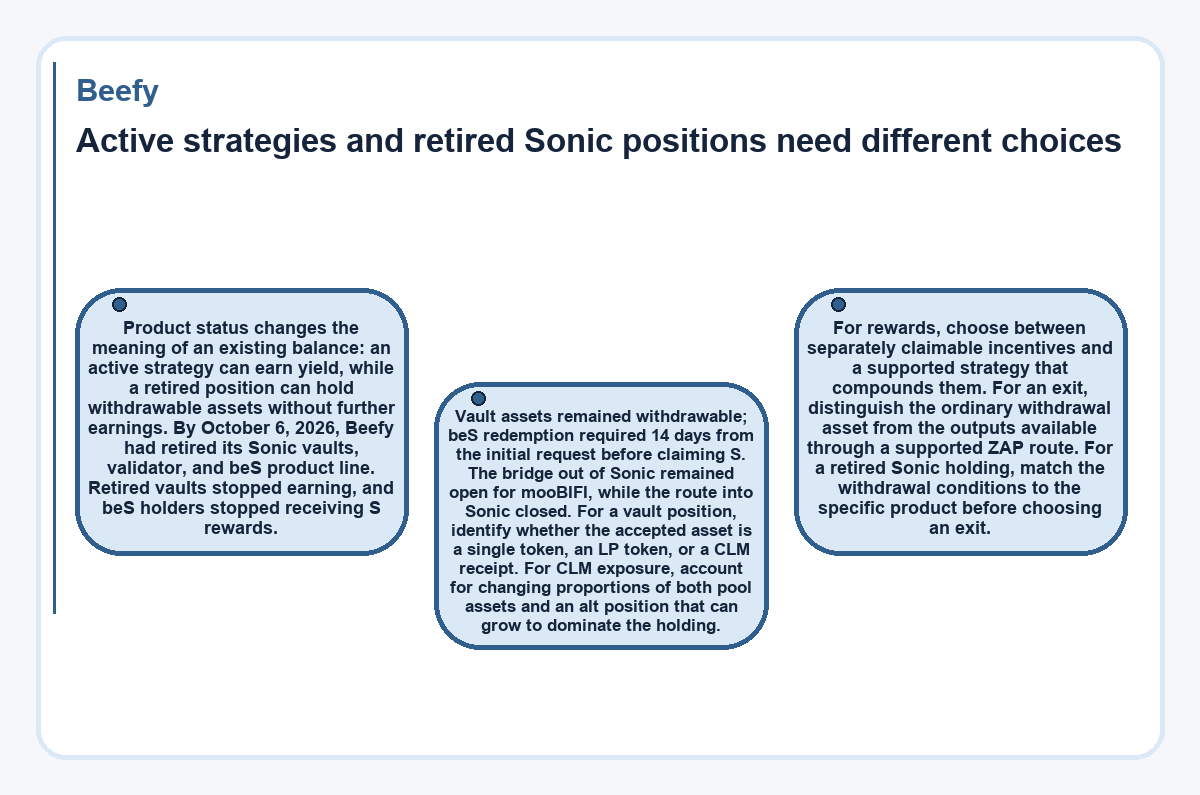
By October 6, 2026, Beefy had retired its Sonic vaults, validator, and beS product line. Retired vaults stopped earning, and beS holders stopped receiving S rewards. Vault assets remained withdrawable; beS redemption required 14 days from the initial request before claiming S. The bridge out of Sonic remained open for mooBIFI, while the route into Sonic closed.
- For a vault position, identify whether the accepted asset is a single token, an LP token, or a CLM receipt.
- For CLM exposure, account for changing proportions of both pool assets and an alt position that can grow to dominate the holding.
- For rewards, choose between separately claimable incentives and a supported strategy that compounds them.
- For an exit, distinguish the ordinary withdrawal asset from the outputs available through a supported ZAP route.
- For a retired Sonic holding, match the withdrawal conditions to the specific product before choosing an exit.
Beefy FAQ
Do I need BIFI to deposit into a regular vault?
Regular vaults require their specified deposit asset, so BIFI ownership isn’t a general entry requirement. BIFI is the underlying deposit asset for BIFI-specific pools and vaults; a supported ZAP route can obtain it from another token. The relevant requirements are a token accepted by the chosen deposit route, a wallet compatible with its network, and enough native currency to pay transaction gas.
What happens to compounding while mooTokens are staked in a Boost?
Underlying vault compounding continues while mooTokens are staked in a Boost. The receipts retain their interest-bearing share of that vault. Boost participation adds separately accruing partner rewards above the ordinary vault earnings. The Boost campaign’s reward schedule and the underlying strategy’s harvesting schedule govern different earnings.
When a Boost ends, do my mooTokens return automatically?
A completed Boost requires manual unstaking of its mooTokens. The campaign ending doesn’t automatically return the receipts to your wallet. Its claim-and-unstake function returns the staked receipts and earned partner rewards. The underlying vault share continues to exist while its receipt tokens remain in the Boost.
Can I transfer mooTokens to a different wallet?
Transferring mooTokens transfers the vault claim that those tokens represent. A wallet holding them can redeem the corresponding share, subject to the product’s withdrawal conditions. Sending them away removes that claim from the original wallet. Receipt tokens staked in a Boost need to be unstaked before a wallet transfer.
Which fee does the percentage in a CLM product name describe?
The percentage identifies the trading-fee tier of the underlying concentrated liquidity pool. That fee applies to traders’ swaps through the pool and contributes to liquidity-provider earnings. It isn’t the vault’s performance fee. A higher tier alone doesn’t establish higher returns because earnings also depend on trading volume.
Why can a CLM deposit fail during a rapid price move?
A CLM deposit can revert when the pool price fails its calmness check. The check compares the current price with the pool’s time-weighted average price to limit exposure to manipulated entry prices. A reverted deposit doesn’t create a funded share. This protection concerns deposit conditions; it doesn’t remove the position’s later market risk.
Does a submitted transaction mean my vault deposit has completed?
A vault deposit completes only after its transaction succeeds onchain. A submission message describes a pending transaction, and a wallet signature authorizes an action. Neither establishes that the vault received funds. The successful deposit transaction and its receipt-token result establish the vault deposit; a reverted deposit doesn’t create a funded vault share. For a crosschain ZAP, source-chain success alone doesn’t establish that the destination deposit completed.
Can a ZAP slippage limit prevent price impact?
A slippage limit doesn’t prevent the price impact that a swap causes in its liquidity pool. Slippage concerns changes between the quote and execution; price impact describes the swap’s effect on the pool price. Thin liquidity can produce an unfavorable conversion quote even when execution stays within the allowed slippage.